
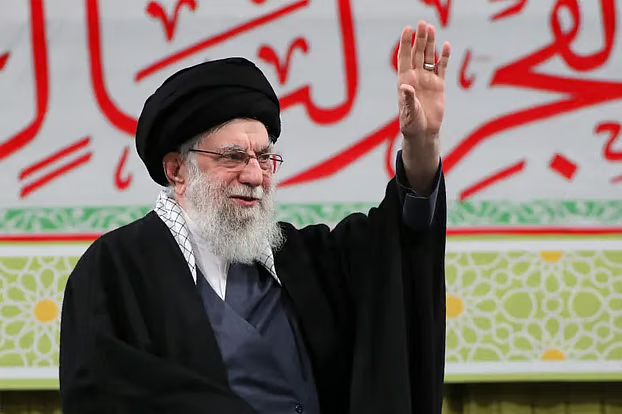
Amid ongoing tensions between Washington and Tehran, Iran's Supreme Leader Ayatollah Ali Khamenei has warned that a US attack on Iran would lead to a regional conflict, state media reported on Sunday.
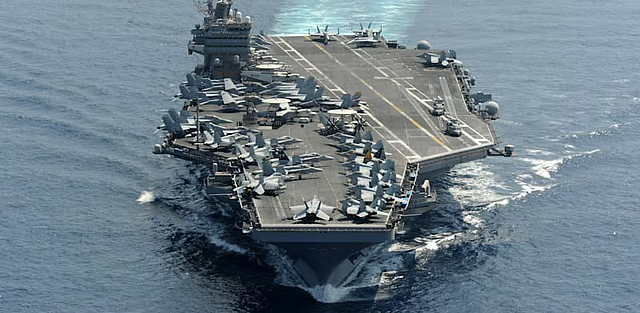
The United States has recently strengthened its naval presence in the Middle East, as US President Donald Trump has repeatedly threatened military intervention to force Iran into a nuclear deal or to demand an end to its crackdown on protesters.
Criticizing the US president's move, Khamenei said, "Trump is constantly threatening warships. The Iranian nation will not be afraid of these things, and the Iranian people should not be disturbed by these threats."
Khamenei also said, "We do not want to start any war and we do not intend to attack any country. However, if anyone attacks or tries to harass the Iranian nation, they will be dealt a severe blow."
Seeking a diplomatic solution
The path to a diplomatic solution to reduce Iran-US tensions is still considered open. Tehran has said it is ready for fair talks. However, those talks should not include any conditions that would reduce the country's defense capabilities.
The US Navy currently has six destroyers, an aircraft carrier, and three littoral combat ships deployed in the Middle East region.
Protests in Iran, which began in late December over economic hardship, have become the country's most difficult political challenge since the founding of the Islamic Republic in 1979. However, the intensity of the protests has now subsided in the face of widespread repression.
According to official figures, 3,117 people have died in the unrest in the country. However, the US-based human rights organization HRANA said today that it has confirmed the death toll to 6,713 so far.
According to Iranian state media, Khamenei compared the protests to an attempted coup, saying the main goal of the uprising was to strike at the country's centers of governance.
Progress in negotiations
While Iran's military chief is warning Washington of a military strike, the country's top security official claimed on Saturday that progress had been made in talks with the United States. Trump confirmed the talks between the two countries, but also maintained the threat of attack.
Ali Larijani, head of Iran's Supreme National Security Council, said that structural preparations for talks are underway, in contrast to the media's propaganda of war. Larijani made the announcement after meeting with Russian President Vladimir Putin in Moscow.
Yesterday, Iranian President Masoud Pezeshkian said that any major conflict would be harmful to both Iran and the United States. In a phone call with Egyptian President Abdel Fattah al-Sisi, he said that Iran has never sought war and that they firmly believe that war will not serve the interests of Iran, the United States, or anyone in the region.
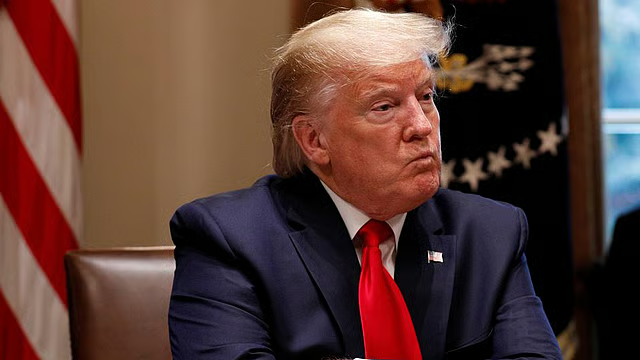
Trump later confirmed the talks in an interview with Fox News, saying, "Iran is talking to us. Let's see if we can do something. Otherwise, we'll see what happens."
Qatar's Foreign Ministry said Prime Minister Sheikh Mohammed bin Abdulrahman Al Thani met with Larijani in Tehran on Saturday to defuse tensions in the region.
Meanwhile, Iranian Army Chief of Staff Amir Hatami warned the United States and Israel that his forces were fully prepared for military and defensive action. He said that if the enemy made any mistake, they would definitely endanger their own security, the security of the region and the Zionist regime.
.png)
0 Comments