

It is believed that there is considerable tension among high-ranking officials of China's People's Liberation Army (PLA).
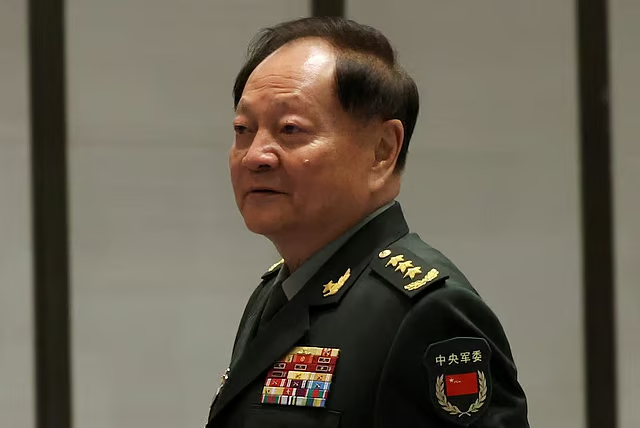
China's top general Zhang Yuxia and another senior military official, General Liu Zhenli, were dismissed last weekend, raising serious questions about the power struggle within the country's elite.
What is the reason behind this incident? There has been public curiosity about the impact it could have on China's military capabilities, especially its ambitions to seize Taiwan or engage in other major regional conflicts.
Zhang, 75, was vice chairman of the Central Military Commission (CMC), the group of the Communist Party led by the country's leader Xi Jinping that controls the armed forces.
The CMC, which usually consists of seven members, is now down to just two members. Among them are Xi Jinping himself and General Zhang Shengmin.
After several previous arrests, all the others have been removed in the ongoing 'anti-corruption' campaign.
The CMC is responsible for controlling millions of military personnel. The organization is so powerful that the only position held by Deng Xiaoping as China's sole ruler was that of chairman of the CMC.
According to Lyle Morris of the Asia Society Policy Institute, the fact that only Xi and one general are now left in the CMC is unprecedented.
Morris told the BBC that the PLA is now in a state of chaos. There is now a huge leadership vacuum in the Chinese military.
Asked about the real reason for removing so many top generals, Morris told the BBC, "There are a lot of rumors circulating in the market. We don't know yet which of them are true and which are false. But it is definitely a negative message for Xi Jinping's leadership and his control over the PLA."
Associate Professor Chong Ja Yan of the National University of Singapore also said he was not sure of the exact cause of Zhang's downfall, but there was much speculation.
Yan said there are rumors of everything from leaking nuclear secrets to the United States to coup plots and internal factional strife. There are even rumors of shootings in Beijing.
But the fall of Zhang and Liu and these speculations have made two things clear: first, Xi Jinping is still invincible, and second, the flow of information in Beijing is extremely limited, which is fueling uncertainty and rumors.
The Beijing government has announced that it is "investigating" Zhang and Liu, accusing them of "serious violations of discipline and law," which is essentially a fancy term for corruption.
Then, in an editorial, the PLA Daily made it very clear that this move was a manifestation of the Communist Party's 'zero tolerance' policy in 'fighting corruption', regardless of who the person accused of corruption is or how high his or her rank is.
The specific charges against these generals have not been made public. Perhaps never will be. But the fact that they are being investigated means that they will almost certainly face prison sentences.
An editorial in the PLA Daily has already castigated Zhang and Liu as guilty, saying they had "grossly betrayed the trust and expectations of the Communist Party Central Committee" and "trampled on and humiliated the Central Military Commission."
The targeting of generals may be due to corruption, but past experience suggests that power politics may also be behind it.
China certainly had a corruption problem when Xi Jinping came to power, but the Chinese leader has been accused of using the party's fearsome "discipline inspection team" to remove political rivals or government officials who are not loyal to him.
As a result, General Secretary Xi Jinping has achieved a level of absolute control not seen since Chairman Mao.
However, such leadership can also be counterproductive. For example, if a climate of suspicion is created in the military, it can lead to caution and even weakness in decision-making.
Zhang's father was a revolutionary comrade of Xi's father. The general's long-standing relationship with Xi and the two were considered close allies before the recent chaos. Their separation may have made the situation even more dire, as it is now believed that no one is safe in China.
Zhang was one of the few combat-experienced senior officers in the PLA. His departure is a great loss for the military.
According to Lyle Morris, removing Zhang could create problems for Xi in the long term. Xi may have reasserted his authority. But the chaos will create long-term tensions within the PLA.
The expulsion of the most senior generals has also raised questions among lower-level officials, who will be next? Seeing the fate of senior officials, they too may not want to be promoted to the "danger zone" where Xi's anti-corruption watchdog could fall on them at any time.
All this is happening at a time when Beijing is increasing pressure on Taiwan and threatening to seize the self-ruled island with a full-scale invasion at any time.
Analysts are examining how much these removals will hinder the possibility of seizing Taiwan, although some believe they will have little impact on Beijing's ambitions.
Yan said their expulsion would not have any impact on China's efforts to control Taiwan. Because that is a matter for the entire CCP and Xi in particular to decide. Where it could have an impact is in military operations. In the absence of top military professionals or if they are intimidated, the decision to launch an operation in Taiwan would be entirely dependent on Xi's personal preferences and mood.
.png)
0 Comments