
At the beginning of World War II, the opposing forces were very weak and helpless in front of Hitler's Nazi forces equipped with sophisticated weapons on various battlefields. The Axis powers were winning one war after another with great success. Their main strength was lightning attacks. In addition to air attacks, the Axis infantry forces quickly entered and occupied one area after another.

Stalingrad (now Volgograd) is a historic city on the banks of the Volga River. From August 23 to 26, 1942, about 600 Axis warplanes indiscriminately bombed this industrial city in the Soviet Union, razing it to the ground. The aerial bombardment was a preparation for the German-led Axis infantry offensive in Stalingrad. But they could not have imagined the danger that awaited them in the city.
By then, World War II had taken a terrible turn. The Axis powers, led by Adolf Hitler's German forces, had occupied almost all of Europe. The Axis powers included Germany, Italy, Japan, Romania, Hungary, Bulgaria, and a few other countries.
The countries of the Allied Forces against the Axis Powers were the United Kingdom, France, the Soviet Union, the United States, and China.
At the beginning of World War II, the opposing forces were very weak and helpless in front of Hitler's Nazi forces equipped with state-of-the-art weapons on various battlefields. The Axis powers were winning one war after another with great success. Their main strength was lightning attacks. In addition to air attacks, the Axis infantry forces quickly entered each region and occupied it.
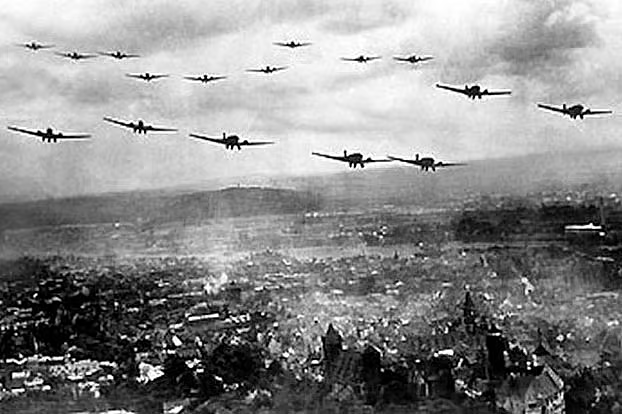
June 22, 1941, was a very important day in history. On this day, under the command of Adolf Hitler, a large fleet of German troops began their journey eastward to conquer the Soviet Union. By then, two-thirds of Europe was under Hitler's control.
Three large groups of German forces set out to invade the Soviet Union, each containing at least three million soldiers.
At that time, the German army was much stronger than the Soviet Red Army in terms of strength and strategy. The German army had already occupied much of the European part of Russia through Ukraine. Hitler's goal was to defeat the Soviet Union as quickly as possible.
German forces quickly reached the outskirts of Moscow. But the Moscow campaign failed in the face of the severe winter of December 1941 and the fierce resistance of the Red Army. Although the Soviet army suffered heavy losses in the battle, Hitler, who had failed to capture Moscow, was not one to be discouraged. This time he himself took charge of the Eastern Front.
Hitler decided to seize the oil fields of Chechnya first. The German forces stationed in the Soviet Union were running out of oil. For this reason, Hitler sent part of his Eastern Front to the Caucasus region of the Soviet Union, that is, to Chechnya. He sent the other part towards Stalingrad.
On July 19, 1942, the German Sixth Army set out to capture Stalingrad. At that time, Hitler's Nazi army was a terror. Against this terror, the leader of the Soviet Union, Joseph Stalin, was desperate to keep the morale of the countrymen.
Stalin was determined to retain control of the city that bore his name at all costs. Stalingrad was home to 400,000 people at the time. When news of the advancing German army arrived, most of the city's grain reserves were evacuated, but the residents were told to stay put.
Preparation for war
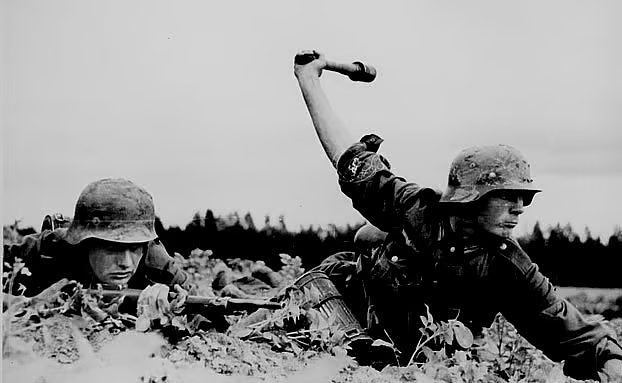
Local militias were formed in Stalingrad to hold back the German forces. Women also joined the forces. They were ordered to hold every block, every street, and every building against the enemy for as long as possible.
On August 4, Axis forces crossed the Aksai River and headed towards the outskirts of the city of Stalingrad.
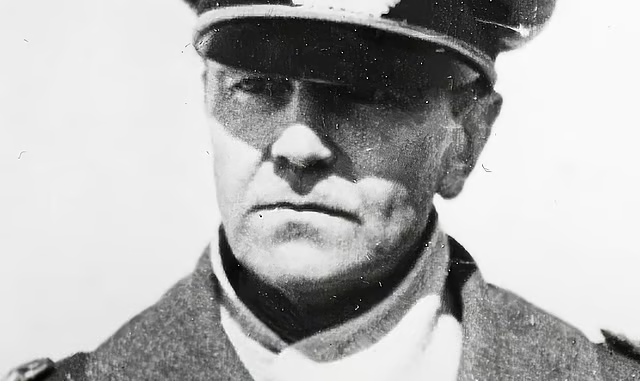
The Axis forces named the campaign to capture Stalingrad 'Operation Heron'. The operation was entrusted to German General Friedrich Paulus, commander of the 'Sixth Army'.
The elite Sixth Army was Hitler's largest and most powerful army. General Friedrich Paulus reached the outskirts of Stalingrad on September 3 with around 300,000 German troops.
Before that, after a massive bombardment lasting for about three days from August 23, German troops entered the main city on September 12.
Rattenkrieg or Rat War
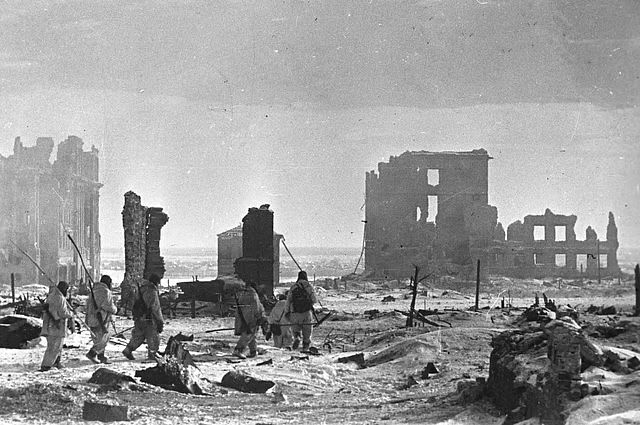
Stalingrad had been largely reduced to rubble by three days of heavy bombing, but that didn't mean the German troops had easy access to the city.
Instead, in Stalingrad, German troops had to advance by clearing rubble every meter, clearing ditches, sewers, and underground hiding places. Their main fear was snipers hiding with guns, and if they were not careful, they would be killed by a long-range bullet.
But the German troops were completely unprepared for the unknown enemy they encountered as they entered the city. The Soviets deliberately hid their tanks in the rubble. Their presence was not detected until the enemy troops were within range, and their fire would come at them unexpectedly.
The German forces were disoriented by this unfamiliar war strategy of the Soviet Union's Red Army. They called this strategy 'Rattenkrieg' or rat war.
In such difficult conditions on the battlefield, German commanders were struggling to decide how to lead their troops. At that time, one of their commanders decided on a strategy to form 'shock groups' of 50 to 100 soldiers each.
These groups had complete freedom of decision-making. They would decide on their own tactics to deal with the enemy immediately, according to the situation.
Private Wilhelm Hoffmann, a soldier in the German Sixth Army, recorded daily accounts of the horrors of war in his diary.
The diary entry dated September 11 reads: 'Our battalion is fighting on the outskirts of Stalingrad. Shooting is going on all the time. Wherever you look, there is fire and blazing flames. Russian cannons and machine guns are firing like madmen from the burning city.'
On September 16, he wrote—'Our army is attacking the granary with tanks. Our battalion is suffering heavy losses in the fighting. The tall building of the granary is occupied not by people, but by monsters, who cannot be destroyed by any bullet or fire.'
September 18: 'The fighting continues inside the granaries. If all the buildings in Stalingrad are held up like this, none of our soldiers will be able to return to Germany.'
Every broken building is a fortress.
Soviet Army Private Anton Bosnik explained why German troops faced so much resistance to take control of each building in Stalingrad.
"We retreated from one building to another, turning each building into a fortified fortress," Bosnik said. "A soldier would only leave his position when the ground beneath his feet was on fire and smoke was coming out of his clothes."
In this way, the ruined buildings of Stalingrad became Soviet strongholds. It was seen that the areas that the German troops occupied during the day were recaptured by the Soviet forces at night.
Germany's sophisticated artillery and armor were useless against the Soviets' sneak attacks. The entire war then turned into a face-to-face battle. And Stalingrad became a nightmare for the German army.
The battle for capture and counter-capture weighed heavily on the German forces. They had to capture Mamayev Kurgan, a hill on the outskirts of Stalingrad, 14 times in total. Despite the fierce winter, the snow on the hill did not accumulate. There was so much shelling that all the snow melted and fell.
However, despite all this resistance, German troops were able to take control of about 90 percent of Stalingrad.

German forces trapped in counterattack
At one point, it seemed that Stalingrad was finally going to fall. Meanwhile, the Soviet forces retreated, but they did not give up hope. The Soviet forces, led by Lieutenant-General Nikolai Fedorovich Vatutin, devised a new plan.
The Soviets again adopted a new strategy. Instead of attacking the strong German forces that had captured Stalingrad, they decided to attack the weakest parts of the Axis defense line. The weak parts were the Romanian Third and Fourth Armies, the Italian Eighth Army, and the Hungarian Second Army. They were coming to Stalingrad to support the German forces in the fight.
On 19 November, two Red Army field armies and a tank army, led by Lieutenant-General Vatutin, launched an attack on the Romanian Third Army. The Soviets called their counterattack Operation Uranus. They launched a heavy bombardment of enemy positions before advancing in heavy snow.
On November 20, the Red Army's 51st Army, led by Lieutenant-General Andrei Yeremenko (also known as Yeremenko), attacked the Romanian Fourth Army. The surprise attack completely shattered the Axis forces on both sides of Stalingrad.
On November 23, Soviet troops surrounded the city of Stalingrad from both sides. The German Sixth Army was trapped inside the city.
The powerful German Fourth Panzer Army was only three days' march from Stalingrad, so it was unable to provide any assistance to the Sixth Army inside the city.
As Soviet forces surrounded the city from the outside, the German forces inside were completely isolated by land.
In other words, instead of being blockaded, the German forces were now the victims of the blockade. At that time, the German forces could have broken the blockade and retreated from Stalingrad if they wanted to. That was what General Friedrich Paulus, the head of the German Sixth Army, wanted.
But Hitler wanted the Germans to not move even a hair's breadth. In January 1943, at the beginning of the new year, Hitler promoted General Paulus to the rank of Field Marshal to encourage him. And he gave strict orders that the city must be occupied from within at all costs.
Meanwhile, the besieged German forces were running out of ammunition and supplies. Hitler assured that the necessary supplies and weapons would be delivered by air. At that time, the German troops in Stalingrad needed 800 tons of supplies per day, but the air supply was only 140 tons.
In the end, Hitler allowed the retreat, but with control of the city intact. Meanwhile, the German army, weakened by the lack of weapons and food, was no longer able to do this.
Instead, the trapped German army was divided into many small groups. The soldiers of the Sixth Army began to die one by one from starvation and lack of weapons. It is said that about 150,000 German soldiers were killed in the Battle of Stalingrad, and about 100,000 more were captured.
However, the Soviet Red Army's losses and casualties in this war were much higher.
Surrender of German forces
After nearly six months of fighting, Field Marshal Friedrich Paulus was captured on January 30, 1943. German troops began surrendering on January 31, and by February 2, about 100,000 German soldiers had surrendered.
The captured German soldiers were forced to flee to Siberia. In the end, only about 5,000 of this group managed to reach Germany with their lives.
Reasons for the German defeat
The news of the entrapment of the mighty German army in Stalingrad was not given to ordinary Germans. Even at Christmas in December 1942, the people of the whole country knew that their brave soldiers were fighting with their lives at the risk of death. News of victory would come at any moment. Yet at that time, the German soldiers trapped in Stalingrad were dying from lack of food.
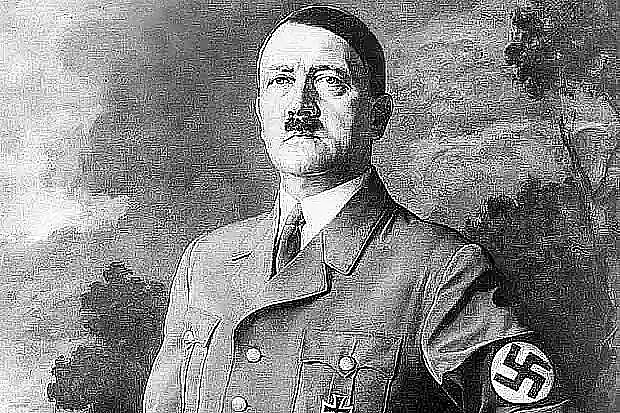
Clearly, some of Hitler's rash decisions played a major role in the German defeat at Stalingrad.
Hitler had become so confident of victory at Stalingrad before winter arrived that the German army was not supplied with enough warm clothing to withstand the severe Russian winter.
Moreover, despite all this, Hitler might have been able to save the elite Sixth Army if he had allowed General Paulus to retreat in early December.
Had he survived the journey, the German army might have been able to turn around the following summer. But Hitler, suffering from overconfidence and national pride, made a suicidal decision to dig the grave of more than 150,000 German soldiers at Stalingrad. It is said that this defeat at Stalingrad turned the tide of World War II, beginning the defeat of the Axis powers.
World War II lasted for 6 years from 1939 to 1945. About 60 million people lost their lives in this war. World War II changed the course of human history. Hitler's decision to attack the Soviet Union is considered one of the reasons for the defeat of the technologically advanced Germans in this war.
References: History.com, WorldHistory.com, BBC
.png)
0 Comments