

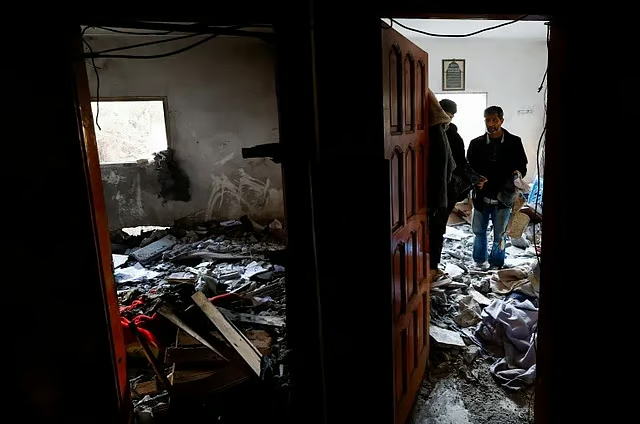
For Gazans, 'peace' is now a distant prospect, both physically and mentally. Although a ceasefire officially came into effect on October 10, Israel continues to violate the ceasefire and frequently attacks. More than 450 Palestinians have been killed in the last three months due to indiscriminate attacks by Israeli forces.
Not only attacks, but also blockades and displacements have disrupted public life in Gaza. In such a tiring situation, the United States announced the start of "phase two" of the ceasefire on Wednesday. US special envoy Steve Witkoff said that this phase aims to disarm Gaza, establish an effective governance system and begin reconstruction.
The new system would include a Palestinian "technocratic" administration overseen by an international "Board of Peace" headed by US President Donald Trump.
Good on paper, but doubtful in reality
While this plan sounds good on paper, the people of Gaza are deeply skeptical. Because they cannot easily believe anything given the horrific attacks and destruction they have witnessed since October 2023.
"Many of the politicians' decisions are far removed from the reality in Gaza," said Arwa Ashour, a journalist and writer in Gaza City. "We spend our days surrounded by siege, fear, death, and living in tents. Whenever a decision is made to alleviate suffering, the Israeli authorities block it."
"People want schools, hospitals and freedom of movement like before," Ashur added. "If this 'peace board' can solve these problems, we welcome it. But if they can't, what's the point?"
Is a solution possible without the Palestinians?
After 18 years of Hamas rule and two years of brutal war, the people of Gaza want change. But they want to be part of shaping their own future, not accept decisions imposed from above.
Under the plan, a Palestinian committee headed by former deputy minister Ali Shath would handle day-to-day administrative work. But the committee would be overseen by a "peace board" headed by former Bulgarian minister Nickolay Mladenov. Although Mladenov is an experienced diplomat, there are questions about how much pressure he will be able to exert on Israel or protect Palestinian rights.
"Making decisions that exclude those whose lives are most affected in Gaza is tantamount to restoring the old governance structures that have allowed this occupation and genocide to continue," said human rights activist Maha Husseini.
বাংলাদেশ থেকে আরও পড়ুন
Political complexity
Political analyst Ahmed Fayyad believes that the Palestinians have no choice but to accept the Mladenov or this peace board model. Because neither the Palestinian Authority (PA) nor any of the Arab countries want to destroy the agreement now. However, the disarmament of Hamas and the internal conflict among the Palestinians could become major obstacles.
Israel also does not want Gaza to reach an independent political solution. "Israel wants Gaza to be just a demilitarized zone and its people to forget about political rights and just be busy with the daily struggle for survival," Fayyad said.
Current life in Gaza
Sami Balusha, a 30-year-old computer programmer from Gaza City, said that for him, peace means very simple things - sleeping safely at night and waking up healthy in the morning. He has had to flee from one place to another 17 times because of the war.
"No one listens to us seriously," Sami laments. "I fear that the next generation may accept this hellish life as normal. People are so tired now. They just want this misery to end, no matter what."
Related topics:
.png)
0 Comments