
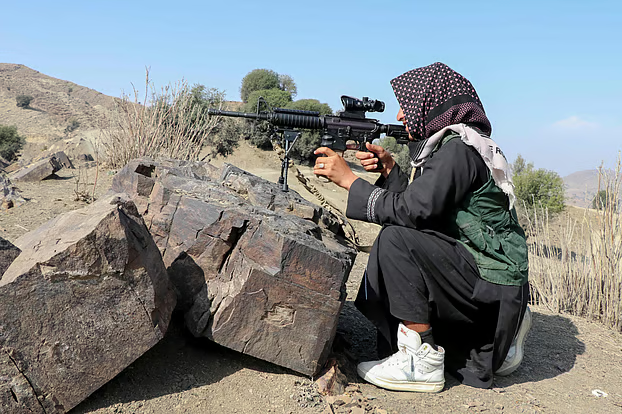
The Pakistan-Afghanistan border area has been witnessing intermittent clashes for several days. In this context, Pakistan has carried out airstrikes in the Afghan capital, Kabul, and several other cities in the country.
Pakistan's Defense Minister Khawaja Asif said on Friday that Islamabad's patience with the Taliban authorities in Afghanistan has run out and that Pakistan will now enter a "virtual state of war."
The announcement came hours after Taliban spokesman Zabihullah Mujahid made a statement alleging that Afghanistan was carrying out a "large-scale military operation" against Pakistani forces along the Durand Line that divides the two countries.
The situation comes after weeks of clashes along the border between the two countries, in which both sides have claimed hundreds of lives.
Tensions between Pakistan and Afghanistan have been rising since the Taliban returned to power in 2021. That continuity has led to today's hostile and conflictual situation.
What really happened?
Pakistani officials said today that Afghan forces had attacked military positions near the border. In response, Islamabad launched airstrikes inside Afghanistan, hitting targets in the capital Kabul and other cities.
There were reports of shelling and gunfire near the important Torkham border crossing between Afghanistan and Pakistan this afternoon.
Al Jazeera correspondent Nasser Shadid said Pakistan launched the first attack at around 1:50 am local time on Thursday. Afghan forces responded with anti-aircraft fire.
Pakistan's Defense Minister Khawaja Asif wrote on social media, "Our patience has broken. Now a direct war has begun between us and you."
Pakistan has named this operation 'Operation Ghazab Lil-Haq'.
Where in Afghanistan did Pakistan attack?
Pakistan's Information Minister Ataullah Tarar wrote on Twitter that attacks had been carried out on "Afghan Taliban defense targets" in the capital Kabul, southeastern Paktia province and southern Kandahar. Meanwhile, the country's Defense Minister Khawaja Asif said Pakistan was "virtually in a state of war" against the Taliban government.
The border between Afghanistan and Pakistan, known as the Durand Line, is 2,611 kilometers long. Afghanistan has not officially recognized the border, arguing that it is a colonial boundary that unfairly divides ethnic Pashtun areas into two.
Afghan government spokesman Mujahid X confirmed the attacks in these three provinces in a post.
The Associated Press (AP) reported that two brigade bases in Afghanistan were destroyed in the attack, citing two senior Pakistani security officials who spoke on condition of anonymity.
Pakistan's state media outlet Pakistan TV claimed in a report that its forces had "overthrew" several Taliban positions within a few hours.
The Afghan Taliban are unlikely to take tough action against the TTP. In addition to the two groups' long-standing alliance, the Afghan Taliban fear that TTP fighters could join the Taliban's main rival in Afghanistan, the Islamic State Khorasan Province (ISKP).
According to the media outlet, the locations hit in Afghanistan included a Taliban brigade headquarters and ammunition depot in Kandahar. In addition, attacks were also carried out on Taliban outposts in Wali Khan sector, surrounding areas of Shawal sector, Bajaur sector and Angur Adda.
Pakistan's Information Ministry said it was also conducting operations targeting Afghan Taliban forces in several districts of Pakistan's Khyber Pakhtunkhwa province, including Chitral, Khyber, Mohmand, Kurram and Bajaur.
There were reports of shelling and gunfire near the important Torkham border crossing between Afghanistan and Pakistan this afternoon.
Al Jazeera's Kamal Haider and AFP news agency reported from Islamabad that gunfire was heard near the border crossing this morning. Afghan troops are advancing towards the border.
The land border has remained largely closed since October due to fighting between the two neighbors. Despite this, the Torkham crossing has remained open for the return of a large number of Afghan citizens from Pakistan.
What is known about the casualties
There are widespread discrepancies in the casualty figures provided by both sides.
Pakistani Prime Minister's spokesman Musharraf Zaidi wrote in an early morning tweet that 133 Afghan Taliban members were killed and more than 200 wounded in the morning attack. He added that 27 Taliban checkpoints were destroyed and nine were taken over. In addition, more than 80 "tanks, artillery and armored vehicles equipped with weapons were destroyed."
We have recently seen several major terrorist attacks inside Pakistan. So it is unfortunate but not surprising that tensions have reached a peak and the situation has deteriorated to such an extent after a series of attacks.
Dawn reported that 274 Afghan Taliban soldiers and 'Kharijite' militants have been killed so far in the ongoing 'Operation Ghazab Lil-Haq' operation of the Pakistani military. This information was given by the Director General of Pakistan's Inter-Services Public Relations (ISPR) Lieutenant General Ahmed Sharif Chaudhry at a press conference in Islamabad today.
Sharif Chowdhury also said that more than 400 Afghan soldiers were injured in the operation. In addition, 73 Taliban posts were destroyed and 17 posts were taken under control in the attack by the Pakistani forces. According to initial estimates, at least 115 tanks, armored vehicles and artillery of the Afghan forces were destroyed.
On the other hand, the Taliban government said that only 8 of its fighters were killed and 11 were wounded.
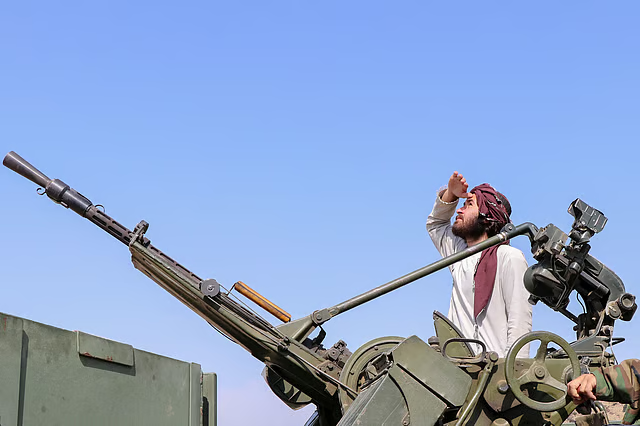
Afghanistan said it launched counterattacks on Pakistani bases and posts along the border early Friday in retaliation for Pakistan's attacks inside the Afghan border last Sunday. It claimed that Afghan forces killed 55 Pakistani soldiers and captured two military bases and 19 posts. Pakistan rejected the claim.
Pakistan claimed to have killed at least 70 "militants" in the airstrikes on Sunday. However, Taliban spokesman Mujahid denied the claim, according to media reports. He wrote in X that dozens of people, including women and children, were killed in the attack.
Maulvi Fazal Rahman Fayyaz, provincial director of the Afghan Red Crescent Society in Nangarhar province, said 18 people were killed and several others were injured in Sunday's attack.
Former Afghan President Hamid Karzai, who is no longer in office, remains influential. He said the country's people "will remain completely united under any circumstances to defend their beloved homeland and respond courageously to aggression."
In a post on Friday, Karzai also wrote, "Pakistan will not be spared from the violence and bombings it has created. They should change their policies and choose the path of good neighborly behavior, respect and civilized relations with Afghanistan."
Why are Pakistan and Afghanistan at war?
The current outbreak of violence between these two countries is the culmination of the tensions of the past few months.
Afghanistan and Pakistan agreed to an immediate ceasefire in October 2025, mediated by Qatar and Turkey, after weeks of fierce and deadly border clashes.
The border between Afghanistan and Pakistan, known as the Durand Line, is 2,611 kilometers long. Afghanistan does not officially recognize the border, arguing that it is a colonial border that unfairly divides ethnic Pashtun areas into two.
The two neighboring countries have been embroiled in frequent clashes since the Taliban seized power for the second time in 2021. Sami Omari, an expert on security and strategic affairs for South and Central Asia, told Al Jazeera that there have been 75 clashes between Afghan and Pakistani forces since the withdrawal of US and NATO forces from Afghanistan in 2021.
Pakistan wants the Afghan Taliban authorities to control armed groups like the Tehreek-e-Taliban Pakistan (TTP), which Pakistan claims is harboring. The TTP emerged in Pakistan in 2007. It is separate from the Afghan Taliban, but the two groups share deep ideological, social and linguistic ties.
For several years, the TTP and the Balochistan Liberation Army (BLA), active in the mineral-rich province of Balochistan, have increased their armed attacks in Pakistan. They have carried out most of their attacks in the provinces of Khyber Pakhtunkhwa and Balochistan, which border Afghanistan.
"The Afghan Taliban are probably not willing to take tough action against the TTP," Pearl Pandya, senior South Asia analyst at the non-partisan conflict monitoring group Armed Conflict Location and Event Data (ACLED), told Al Jazeera. "Along with the two groups' longstanding alliance, the Afghan Taliban fear that TTP fighters could join the Taliban's main rival in Afghanistan, the Islamic State Khorasan Province (ISKP)."
Pandya added that a major conflict is "inevitable" if the Afghan Taliban does not take action against the TTP.
Elizabeth Threlkeld, director of the South Asia Program at the Stimson Center, a Washington-based think tank, told Al Jazeera that the clash was not surprising. It was the result of months of "tense" relations between Pakistan and Afghanistan.
According to Threlkeld, this "more aggressive and forceful attack" by Pakistan is likely a sign of a change in strategy. "We have seen a number of major terrorist attacks inside Pakistan recently. So it is unfortunate but not surprising that tensions have reached such a high level and the situation has deteriorated so much after a series of attacks," he said.
World reaction
India has strongly condemned Pakistan's airstrikes on Afghan territory during the holy month of Ramadan. In a statement, Indian Foreign Ministry spokesperson Randhir Jaiswal said, "This attack has resulted in civilian casualties, including women and children. This is basically another attempt by Pakistan to divert its internal failures into other sectors."
UN Secretary-General Antonio Guterres' spokesman Stephane Dujarric said in a statement that the Secretary-General called on both parties to abide by international law.
Iranian Foreign Minister Abbas Araghchi has urged Afghanistan and Pakistan to resolve their differences through dialogue and good-neighborly behavior. He wrote in an email, "The holy month of Ramadan is a month of restraint and solidarity in the Muslim world. During this time, Afghanistan and Pakistan should resolve their current problems through dialogue."
Russia has called on both sides to immediately stop cross-border attacks and resolve the dispute through diplomatic means, the Russian news agency RIA quoted the country's Foreign Ministry as saying. At the same time, Russia has offered to mediate in the crisis.
.png)
0 Comments