

For the Russian budget, the depth of the crisis in the Middle East in the coming months will be measured in barrels of high-priced oil.
Photo: Pelagia Tikhonova / RIA Novosti
The budget has not yet felt the benefits of the war in the Middle East.
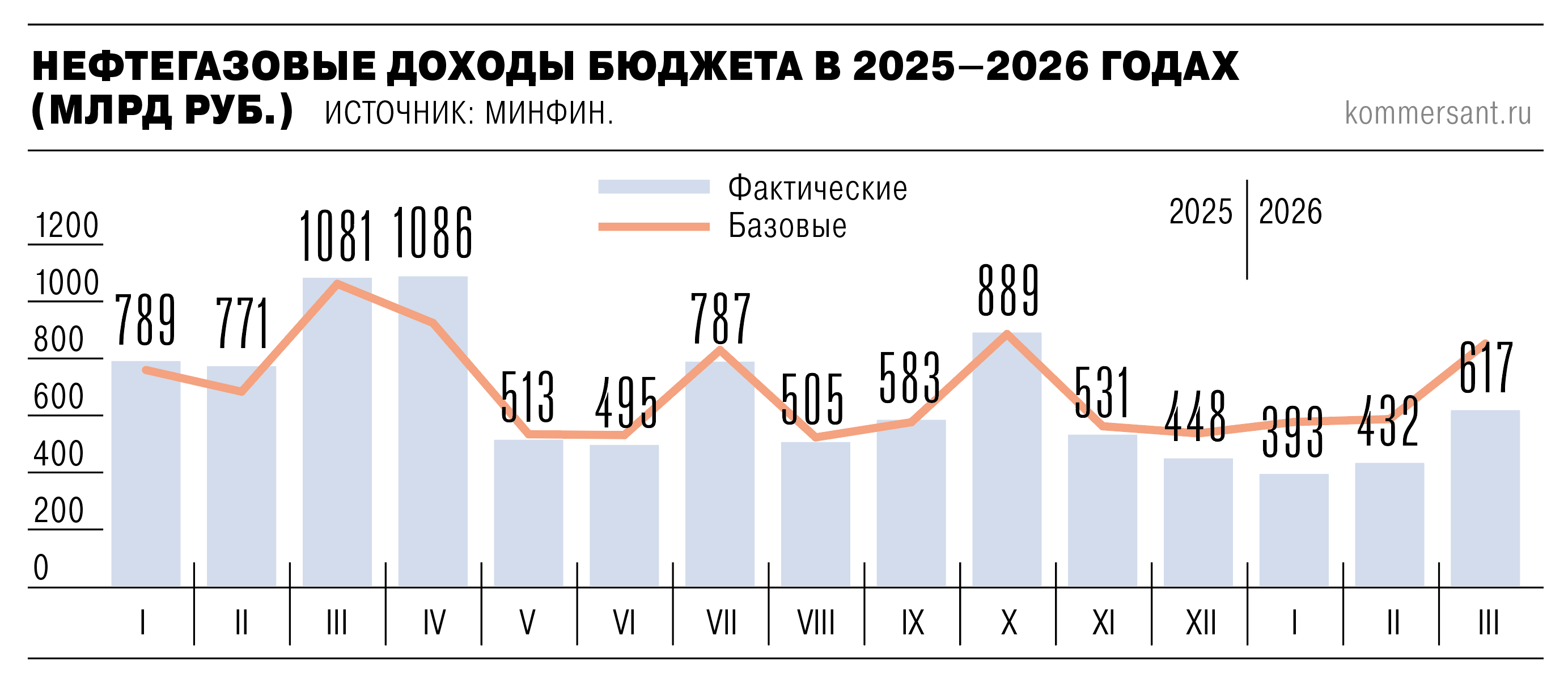
Federal budget oil and gas revenues for March 2026 fell by 43% compared to the same period last year, according to data published by the Ministry of Finance. The drop in revenues amid high oil prices is due to the fact that companies were paying taxes in March based on the February Urals price of $44.6 per barrel. The $77 per barrel price in March will impact revenues in April. Meanwhile, the budget remains in a difficult position: an additional 60 billion rubles were spent from the National Welfare Fund in March to cover the deficit. With the emergence of additional revenues, the situation should improve, and if the current commodity market situation persists, the seemingly unattainable annual oil and gas revenue plan of 8.9 trillion rubles may be exceeded.Expand to full screen
In March, federal budget tax revenues from oil and gas production and sales totaled 617 billion rubles. This is 193.7 billion rubles more than in February, according to data released by the Ministry of Finance on April 3. However, this increase is explained by a calendar factor: in March, the budget received a tax on additional revenue, which oil producers pay four times a year rather than monthly. Excluding this 191.5 billion, March's revenue is comparable to February's.
In a more accurate year-on-year comparison, oil and gas revenues fell by 43% last month and by 45% in the first quarter. The reason for this modest result, amid soaring oil prices, is a time lag in tax revenues. In March, companies paid taxes based on the oil price and the ruble exchange rate in the previous month, that is, February. The price of a barrel of Urals, determined for tax purposes, according to data from the Ministry of Economy, was only $44.6 per barrel in February. The ministry announced the March price, which has already been impacted by events surrounding Iran, on April 3—it is $77 per barrel. This is significantly higher than both the price of Urals last March ($59) and the average annual level (also the cutoff price) set in the 2026 budget (also $59 per barrel).
At the same time, despite the fact that the current price of Urals is higher than the cutoff price, the additional ruble revenues generated by the budget will not be spent for the time being on purchasing foreign currency for accumulation in the National Welfare Fund.
In accordance with a government resolution adopted on March 27, monthly transactions for the purchase and sale of foreign currency and gold have been suspended until July 1, 2026. This effectively means a temporary suspension of budget rule transactions—any additional oil and gas revenues will remain at the government's disposal and can be used for current expenditures. However, as the Ministry of Finance reported, current expenditures may be limited. On March 30, the ministry announced that if the rule is reinstated, "settlement details will be determined, taking into account the volume of deferred purchases and sales of foreign currency and gold"—meaning the transactions may simply be rescheduled for a later date.
It's worth noting that a similar pause in the fiscal rule has already been announced in recent history: in 2022, with the start of the military operation in Ukraine, its effect was suspended, and additional oil and gas revenues were temporarily used for current spending (then, in 2023, the fiscal rule was revived, but in a significantly more lenient version).

As a reminder, in February, even before the escalation in the Middle East, Finance Minister Anton Siluanov, amidst a shortfall in oil and gas revenues, announced an imminent decision to lower the cutoff price. However, following a surge in commodity prices, the Ministry of Finance began to announce that it would adjust the rule for the next three years, in order to balance revenues and expenditures in the medium term amid potential low oil prices.
Meanwhile, amid expectations of additional oil and gas revenues, the Ministry of Finance is forced to withdraw previous foreign currency holdings from the National Welfare Fund. In March, the ministry reported on April 3, 60 billion rubles worth of foreign currency and gold were withdrawn from the fund to cover the deficit, following 244 billion rubles in February and 155 billion in January. As a result, 3.89 trillion rubles remained in the liquid portion of the National Welfare Fund as of April 1.
According to expert estimates, the March price of Urals at $77 per barrel will lead to a near doubling of oil and gas revenues in April, to 1.1–1.2 trillion rubles.
It is impossible to say now how long the favorable situation for Russia on the raw materials markets will last, but if the price of Urals continues to remain at the current level, oil and gas revenues for the whole of 2026 could exceed 10 trillion rubles—with the budgeted (and recently effectively recognized as unrealistic) plan of 8.9 trillion rubles.
.png)
0 Comments